
- When you approach the design of a waste processing facility, what is the first principle you work from?
The first principle is to understand what the project actually needs to achieve. In this field, there is often a difference between what the customer wants and what the customer needs. Quite often, customers do not fully know either, and that is where engineering has to step in.
My role is to bridge that gap and make sure the solution is designed around what will work in practice, not simply around an expectation or a preference.
At the end of the day, the job is not to produce something that looks convincing on paper. It is to produce a facility that performs as promised, operates reliably and remains viable over time.
That means understanding the objectives properly, identifying the technical limitations early, and developing a solution that is grounded in reality rather than assumption. That is where good engineering starts.
- Where do projects most often go wrong when expectations are not aligned with operational reality?
Projects tend to go wrong when systems are designed without fully aligning with the realities they will operate in.
Waste processing facilities are shaped by a number of practical constraints. The nature of the incoming waste, the conditions of the site, the operating environment, and the market for outputs all play a role. If those factors are not properly accounted for at the design stage, the system can become misaligned from the outset.
You may have a design that appears technically sound, but if it is not grounded in how the facility will actually operate day to day, it becomes difficult to sustain.
In this sector, performance is not defined by what a system is intended to do. It is defined by what it can consistently deliver in real conditions over time. When that alignment is missing, that is where projects start to struggle.
- What does it take, in practice, to make a waste processing system actually work over time?
You have to look at the whole chain. It is not just about what comes into the plant or what happens inside it. You need to understand the incoming waste composition, how it is processed, what comes out, and where that output goes afterwards. If one part of that chain does not work, the system as a whole is weakened.
The composition of the waste stream is fundamental. It influences equipment selection, processing logic, contamination levels, throughput and ultimately the quality and value of the outputs. You cannot design around an idealised feedstock. You have to design around the waste you are actually going to receive.
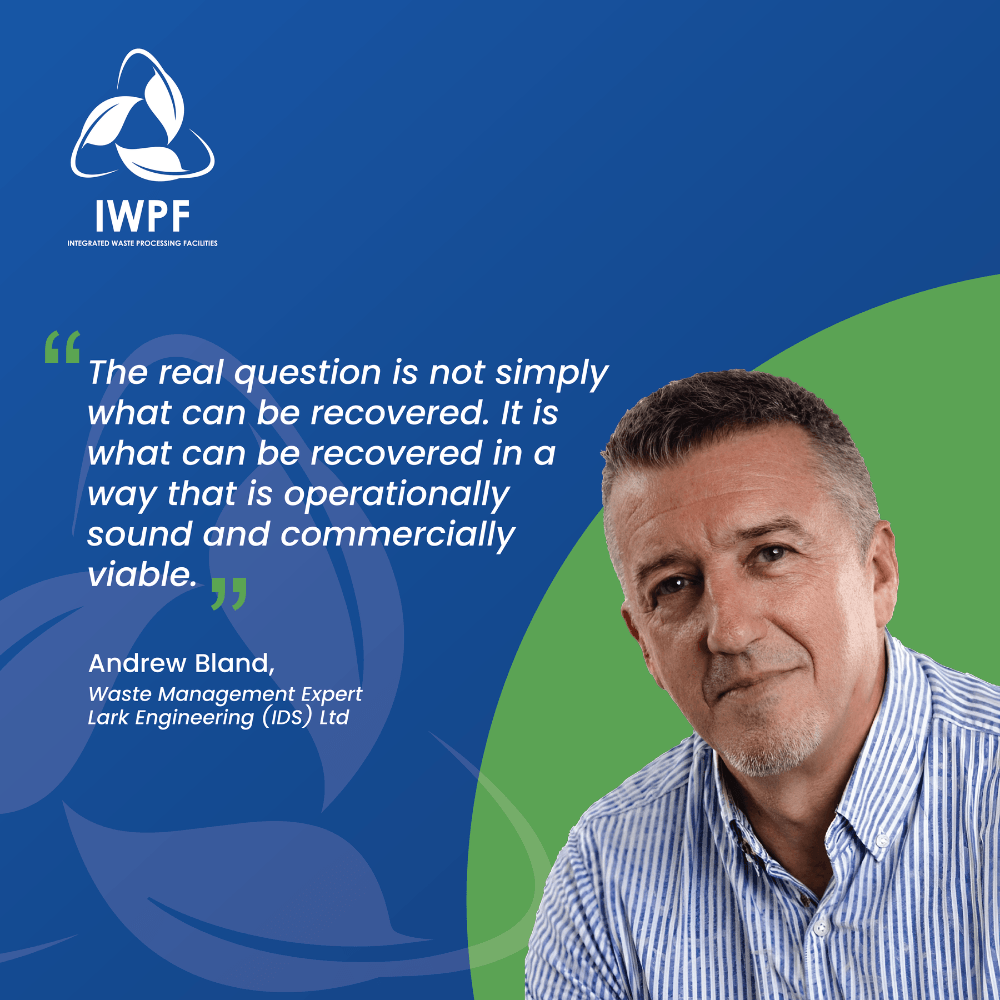
There is always a strong instinct to recover as much as possible, but the real question is not simply what can be recovered. It is what can be recovered in a way that is operationally sound and commercially viable.
A key part of that is finding a home for the output. Once material has been separated or treated, it still has to go somewhere useful. There has to be a market or a downstream use. If there is no realistic destination for that material, then the value of recovery becomes questionable.
From an engineering perspective, commercial viability is not something that always sits comfortably alongside the ideal design philosophy. It is built into it. Every decision has to consider capital cost, operating cost, maintenance, logistics and the value that can realistically be recovered. Technical performance and commercial performance have to reinforce one another if the facility is to remain viable over time.
The ideal design should always be ‘flexible’ enough to evolve as waste composition and market forces change.
- How have local conditions in Mauritius shaped the way IWPF has been designed?
Local conditions have been a central part of the design process from the outset.
Mauritius has its own realities. It is an island environment with land constraints, infrastructure considerations, limited downstream outlets for certain recovered materials, and significant transport costs where export is required. These factors directly influence what is feasible and what is commercially viable.
You cannot take a model from another market and assume it will work in exactly the same way here. A material that may be worth recovering elsewhere is not necessarily viable in Mauritius if the transport and logistics costs outweigh its value.
The design of IWPF has been developed with those realities in mind. This has involved detailed work over an extended period, including site visits, engagement with local stakeholders and authorities, and a close understanding of how the waste stream behaves within the Mauritian context.
Those inputs shape decisions around process configuration, recovery levels, site considerations and the overall operating model. The objective is to ensure that the system is not only technically sound, but aligned with how it will function in practice within the local environment.